
In late April, I spent a morning with people who make our cities and townships work every day. Chief Administrative Officers, city planners, recreation managers, public works directors, finance leads. Not the elected officials who set the vision and cut the ribbons, but the staff, who bring those commitments to life on the ground. The occasion was PLAY Day , co-created and led by Paul Kalbfleisch and David Brenneman, a symposium built around a question that sounds simple but carries real weight: what if we rethought the order of things?
For decades, city-building has followed a familiar framework: Live, Work, Play. It’s the sequence we use to talk about what communities need. But at PLAY Day, that order was challenged. What if Play came first? What if we elevated our public parks, trails, recreation centres, and community centres, not just thinking of them as amenities added after the “important” stuff? What if we appropriately recognized them as the very foundation of how people can participate, connect, belong, and build trust with one another?
It’s a provocation worth sitting with, because the evidence suggests play is doing far more civic work than we give it credit for.
At PLAY Day, I led a panel discussion that drew on new research from the US Chamber of Connection’s Communities of Play Playbook. Though US-based, this research has applicability for Canada, and for Waterloo Region. The data is striking: people who regularly play together, who consider themselves part of a group that gathers around a shared joy, practice or hobby, are measurably more connected in every dimension of civic life.
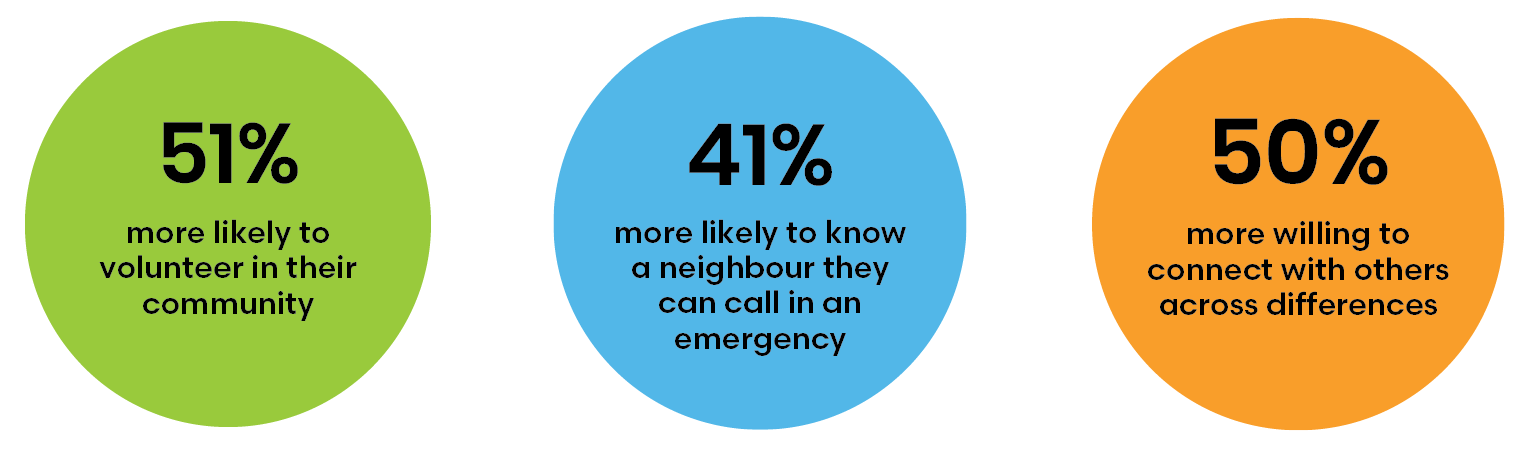
Play, in other words, is not a reward for a well-functioning community. It is one of the things that makes a community function. And yet only 30% of people surveyed say they regularly take part in a community of play. That gap matters, and it lands squarely in the laps of the people who were in that room.
At the event, University of Waterloo Professor Dr. Troy Glover named what he calls “the proximity fallacy”: the mistaken belief that putting people in the same space creates connection. A busy café where no one speaks. A park full of isolated groups. A music festival that brings thousands of people together once a year and then disappears. Simply being near each other isn’t enough. Troy’s research finds that social connection requires spaces that are intentionally designed and programmed to bring people together, and that do so repeatedly. A well-designed space invites interaction rather than passive presence. And it builds rhythms, giving people reasons to return, so that strangers become familiar faces, and familiar faces become neighbours. Connection, he argues, is built through repetition. Without it, we are just sharing the same square footage. And with it, a space becomes a place where we feel we belong.
Phil Fenech of architecture firm Perkins+Will pushed the same idea further: community centres and parks are not just infrastructure for the human spirit. They must be critical infrastructure for social interaction. He challenged planners and community leaders to go beyond asking “what programs will we offer?” to “what type of community do we need to become?” That shift, from delivering experiences to enabling citizen connections, changes how you think about every budget line, every renovation, every new build.
Think about what happened last fall when the Toronto Blue Jays went to Game 7 of the World Series. Millions of Canadians of different ages, backgrounds, and postal codes gathered around something shared. Even in defeat, the collective experience was palpable. People who had never spoken to their neighbours were suddenly talking. Bars were full of strangers cheering together. The same thing is happening right now with the Kitchener Rangers’ playoff run. These moments remind us what shared experience can do. They are a form of social infrastructure and they point to something important: connection across difference doesn’t require sameness. But it does require reasons to show up together.
Sitting in that room of municipal professionals, I felt something like hope. The people responsible for our shared spaces were asking hard questions about purpose and impact, not just capacity and cost. That matters. Because the answer to “what kind of community do we want to become?” has to be lived in the places we build together. And maybe it starts with putting Play first.
JOIN US — JUNE 4, 2026
Shared Places: From Infrastructure to Interactions
Places shape how people meet, interact, and feel a sense of belonging. Join WRCF on Thursday, June 4, 2026, from 8:30–10:30 AM for a Do More Good Dialogue conversation about embedding social infrastructure into places. We’ve invited Daily tous les jours, an award-winning art and design studio from Montreal, to share creative ways places can inspire connection. Daily Tous Les Jours created two installations in the Gaslight District in Cambridge, and their team will provide us with ideas and examples about why “strangers need strange moments together.” We’ll also be presenting several WRCF Community Awards.


Eric Avner
WRCF President & CEO
eric@wrcf.ca