
Vital Signs and Vital Ideas
Vital Ideas® 2026
Vital Signs® tells us how our community is doing. It brings together data, research, and lived experience to highlight the conditions shaping quality of life across Waterloo Region. In 2025, Waterloo Region Community Foundation (WRCF) published a Vital Signs® Report focused on Social Infrastructure.
But a single report can only go so far.
As we shared the findings with community members, a consistent theme emerged: people wanted to go deeper. They had questions, ideas, and stories the data alone couldn't hold. Vital Ideas® responds to that call. It creates space to focus on selected topics raised by Vital Signs® and examine them through new lenses, voices, and perspectives.
Each Vital Ideas® Report centres on one idea linked to social infrastructure, with the potential to shape connection, well-being, and belonging in our community. This second report in the new series, Social Infrastructure and Black Communities, has been created in partnership with Lead Author and Researcher, Teneile Warren, and contains information, community stories, resources, and actions we can take to strengthen the social infrastructure across Waterloo Region.
Vital Ideas® is not about prescribing solutions. It is about asking better questions, deepening understanding, and supporting thoughtful action.
By continuing the Vital Signs® conversation, we can grow and strengthen the social infrastructure across our region.
If you have questions or comments about Waterloo Region’s Vital Signs® or Vital Ideas®, contact info@wrcf.ca.
If you would like a presentation of Waterloo Region’s Vital Signs® or Vital Ideas®, reach out to info@wrcf.ca, and we can coordinate a time to connect with you.
To find out more about Vital Signs® reports published across Canada, visit www.vitalsignscanada.ca.

Click here to visit our webpage that includes all the sources of data and information highlighted in the Vital Ideas® Report on Social Infrastructure and Places.
The 2026 and 2027 series of Waterloo Region’s Vital Ideas® Reports on Social Infrastructure would not have been possible without the funding provided by our sponsors:


“Many conversations I’ve had about social infrastructure in this region eventually lead back to the same question: who gets left out when we build? This report, led by Teneile Warren and grounded in the voices of Black organizers and youth, answers that with clarity and care.
What comes through most is that Black communities here are not waiting for permission to build. Grassroots groups and cultural programming have grown out of necessity and creativity, often without the funding or space to let that work take root for the long term. Black community leaders describe this as a pivotal moment, and I agree. Waterloo Region is growing quickly, and how we invest now will shape whether that growth includes everyone or leaves gaps that widen over time.”
Vital Ideas® 2026 – Social Infrastructure and Places
Why do some places in Waterloo Region keep calling you back?
... because they were designed for connection.
Vital Ideas®: Social Infrastructure and Places is the first report in our Vital Ideas® series. Created in partnership with Lead Author and Researcher, Dr. Troy Glover, it explores how our region can design, invest in, and protect the places that bring people together. The report includes research, community stories, and actions you can take.
Waterloo Region’s Vital Ideas® Report on Social Infrastructure and Places would not have been possible without the funding provided by our sponsors, including Caldwell Group at Richardson Wealth, Equitable, and HIP Developments.
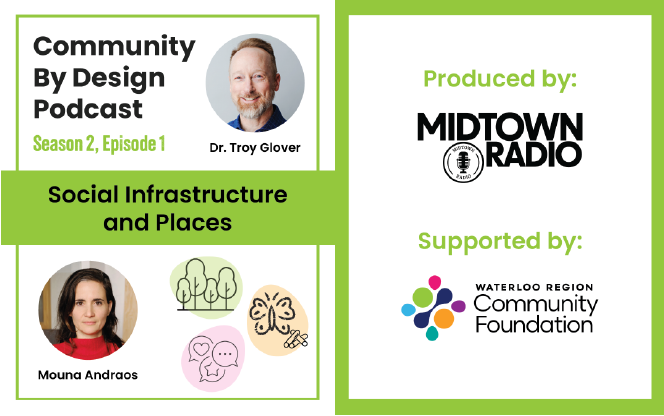
Community By Design Podcast: Social Infrastructure and Places
WRCF partnered with Midtown Radio to produce a podcast focused on sharing insights from the Vital Ideas® Reports.
In the first episode, host Shannon Knelsen brings together Dr. Troy Glover and Mouna Andraos, to share their perspectives on how everyday spaces, repeated encounters, and shared experiences help create community connection.
Click here to visit our webpage that includes all the sources of data and information highlighted in the Vital Ideas® Report on Social Infrastructure and Places.
“At Waterloo Region Community Foundation, we see every day how the spaces we share shape who we become as a community. The research is clear: connection doesn’t happen by chance. It grows in places designed for return, for overlap, for the quiet recognition of a familiar face. Our region’s future depends on whether we invest not just in spaces, but in the conditions that turn spaces into places. I invite community leaders, planners, funders, and neighbours to join us in this work. The opportunity is now.”
Vital Signs® 2025 – Focused on Social Infrastructure
Social infrastructure across Waterloo Region is critical to ensuring our communities are equitable, connected, sustainable, and that people are thriving as we grow to one million residents. As a result, WRCF researched and created the 2025 Waterloo Region Vital Signs® Report focused specifically on social infrastructure – the shared places, shared experiences, and shared resources that enable people to connect with each other in meaningful ways.
This report provides more information about social infrastructure to help people and organizations understand its importance and turn that knowledge into action, so we can all work together to improve it for everyone who lives in Waterloo Region.
Waterloo Region’s 2025 Vital Signs® Report would not have been possible without the funding and support provided by:


Check out pages 58 – 70 in the report to find a section that talks about work that is already happening across our region, along with some local, national and international resources focused on social infrastructure that will help you learn from others and take action locally.

WRCF Do More Good Dialogue: Launch of Waterloo Region's 2025 Vital Signs® Report
On September 10, 2025, WRCF released Waterloo Region's 2025 Vital Signs® Report. Our President & CEO, Eric Avner, invited Steven Ayer, Founder and CEO of Common Good Strategies and the Lead Author and Researcher for the report, to present key findings.
Want to learn more about Social Infrastructure? WRCF continues to research the topic and has created an information hub here that is updated regularly.
Vital Signs® 2021 to 2024 – Focused on Affordable Housing
With affordable housing emerging as a critical issue across Waterloo Region, WRCF created a 2021 Vital Signs® Report focused on the state of affordable housing in our communities. It examined affordable housing through a variety of lenses including economic security, gender, immigration, the environment, children and youth, and for those with disabilities. This report was followed by two compendium reports in 2022.
In 2023, once again WRCF created a Vital Signs® Report focusing on Affordable Housing to provide more information about this important community issue. The Waterloo Region 2023 Vital Signs® Report illustrated how the housing crisis continued to hit our most vulnerable hardest – the young, non-homeowner older adults, newcomers and refugees, those who identify as Indigenous, Black or as a person of colour, those with disabilities, and individuals exiting the child welfare system. This report was widely circulated with requests for presentations and additional data analysis. The resources below include 3 additional presentations and a data-rich blog that further examined Waterloo Region’s municipalities.




Background of Waterloo Region Vital Signs®
Prior to 2017
WRCF partnered with community organizations and leaders to gather and interpret research to create Waterloo Region's Vital Signs® Reports and Vital Signs® Priority Scorecard Reports. Data was collected from various trusted and respected sources including Statistics Canada, Ontario Municipal Benchmarking Initiative (OMBI), Municipal Performance Measurement Program (MPMP), Environment Canada, Region of Waterloo, Canada Mortgage and Housing Corporation, Elections Canada, Crime Severity Index, Ontario Education Quality and Accountability, and Industry Canada.
In addition, community members were asked to assign “grades” in 11 key areas critical to Waterloo Region's quality of life: The Gap Between the Rich and Poor, Safety, Health and Wellness, Learning, Housing, Getting Started in Our Community, Arts and Culture, The Environment, Work, Belonging and Leadership, as well as Getting Around. An expert resource panel then provided insight into the data and indicators chosen for the reports. The reports assisted organizations and individuals across Waterloo Region in making connections between issues and trends in different areas, informed WRCF’s strategic direction and actions to support the community.
We also commissioned a study to further understand the state of belonging in our community (pdf).
Between 2017 and 2020
Rather than conduct our own research, we directed our resources to a community-wide initiative called Wellbeing Waterloo Region. We used the information gathered through that work and subsequent learnings to focus our Granting, Impact Investing and Mobilizing towards the three core issues of Affordable Housing, Healthy Children & Youth, and Social Inclusion.
In 2020, we also held a series of Vital Conversations with Youth, and created a summary report (pdf) in partnership with Community Foundations of Canada and the RBC Foundation.

Community Engagement Toolkit
In May 2022, WRCF released a Community Engagement Toolkit to help developers, not for profits and others in the affordable housing space in listening and responding to community members in the development of places and spaces. Click here to access and download a pdf of the toolkit.