
STRENGTH AND STABILITY: Habitat Waterloo Region’s latest housing project leans heavily on partnerships
$3 million WRCF impact investment paves way forward for Shantz Hill townhouses
Do more, faster.
That’s the intention behind Habitat for Humanity Waterloo Region’s latest building project, 24 stacked townhouses on Shantz Hill Road in Cambridge.
Habitat Waterloo Region has been providing affordable homeownership opportunities to the region for more than three decades. However, a desire for improved productivity recently prompted an organizational shift towards community partnerships.
“This project is a work of partnerships,” Habitat Waterloo Region CEO Philip Mills said, noting his organization has worked with partners before, but not to this magnitude.

At the site of the planned 24-unit affordable housing complex on Shantz Hill Road, Habitat Waterloo Region CEO Phill Mills is joined by Activa’s Alex Sumner, John Hartwick, and Ron Pullman
The Shantz Hill project has partnered with developer Activa on the construction side, while critical funding is provided through an impact investment from Waterloo Region Community Foundation (WRCF).
WRCF currently works to deploy 10% of its assets to local impact investments focused on making social or environmental impacts in Waterloo Region. The $3 million loan for the Habitat Waterloo Region project is the largest WRCF has approved since beginning its impact investment journey in 2017.
John Bowden, WRCF’s Director, Financial Services, said, “the partnership was a natural fit. Interestingly, Habitat Waterloo Region was one of the first organizations that WRCF met with nearly a decade ago when we began investigating potential candidates for impact investments.”
“Given the strength and stability of the organization, and the initiative they are undertaking, it aligns really well with what we’re trying to achieve,” John said, adding Habitat Waterloo Region’s “track record and their history of accomplishing what they set out to do speaks volumes in the community.”
Upon completion in 2026, the Shantz Hill housing project will feature two-, three- and four-bedroom units.
“It’s all the things that Habitat Waterloo Region promises: This is an opportunity for families to have strength, stability, and self-reliance. The benefits of homeownership,” Philip said. “The thing that we talk about at Habitat Waterloo Region is that there is a level of not just pride and commitment, there is control that comes with this. This is an opportunity for stability. For parents and kids to have a place to call home for as long as they want it.”
Habitat Waterloo Region’s homeownership model aims to end the cycle of precarious housing for applicants who have reported struggling to find decent, affordable housing.
As part of the program, these lower-income, working families are required to contribute 500 volunteer hours to support Habitat Waterloo Region’s mission. Mortgage payments are capped at 25% of the gross household income.
“When I think about the families that we’re partnering with, a lot of them were previous refugees. You think about the impact on a family that hasn’t had control of their life. Who hasn’t had an opportunity to say this is ours. Who has experienced conflict or loss by external forces,” Philip said. “The impact of stable housing is massive.”
While Habitat Waterloo Region’s goal is to deliver housing more quickly, the realities of construction are not always so straightforward.
“With the Shantz Hill project, every roadblock imaginable has popped up along the way, including design challenges, building code and zoning issues, and even an appeal to the Ontario Land Tribunal,” Philip said.
Even so, shovels went into the ground in the spring, and the project has been moving at a “lightning pace” since.
“In the end, we’re building faster than we could on our own. We’ll put 24 families into homes they wouldn’t have otherwise had. It’s a win, win, win all around with everybody doing what they’re good at,” Philip added.
In a lighthearted remark, Philip described the partnership with WRCF as “the easiest sell in the world” to the Habitat Waterloo Region Board. "We needed construction financing, and we knew we were going to have to get some loans. The opportunity to say we’re going to get a loan and we’re going to pay interest, knowing that the interest we pay goes back to WRCF to lead work that goes back into our community... it was the perfect alignment on our end.”
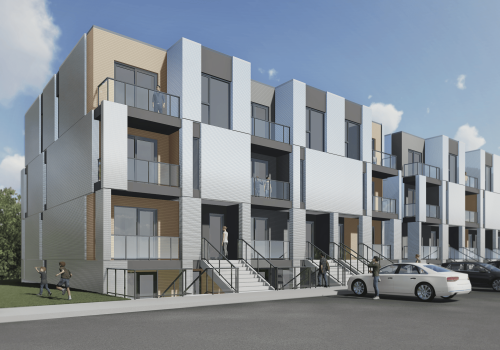
Rendering of Shantz Hill project showing units
Once the Shantz Hill project is occupied, John said WRCF will have participated in helping establish and preserve 801 affordable housing units across Waterloo Region since 2017.
“Investing in affordable housing impacts more than just housing and financial relief. It helps with food security. It provides safer living conditions, which can impact mental and physical health. It improves child well-being: if children have a safe place to sleep and breakfast in the morning, they do better at school. All of these things can lead to someone feeling more connected to the community. And that connection strengthens belonging and civic engagement,” John said. “Habitat Waterloo Region is also thinking about those long-term impacts, and we’re happy to see that built into their policies and their practices.”
As described by Philip, Habitat’s philosophical switch to increasing partnerships within the community is something of a test drive that, if successful, will drive future collaborations.
“How do we, as a community, come together to do more and make more housing available faster than we could on our own? That’s the real benefit of all of us working together,” Philip said. “If this works, we can start bringing more housing into the community to the folks who need it. We’re already seeing the benefits of good partnerships.”
He added: “We can invest in more families, we can connect with more people and hopefully make a broader impact.”
To learn more about Habitat for Humanity Waterloo Region, visit habitatwr.ca.
For more information on WRCF’s impact investing efforts and to apply for an impact investment, go to wrcf.ca/local-impact-investing.