Gaslight District builds social infrastructure by design
Montreal studio behind Cambridge art strives to focus back on ‘human aspect’ of daily lives
Canadians are familiar with the concept of live, work, and play, but what if we shifted that model to play, live, and work?
It’s a question posed by Scott Higgins and Paul Kalbfleisch in The Joy Experiments: Reimagining Mid-sized Cities to Heal Our Divided Society.
Published in 2024, the book explores an array of thought-provoking topics, including increased isolation due to the rise of smartphones and social media. Through the lens of local real estate developer Scott and creative mind Paul, it also tackles urban planning strategy that prioritizes infrastructure for the human spirit.
In essence, how can we foster connections? As Waterloo Region’s population continues to grow, keeping up with physical spaces is one thing; ensuring connectivity among those who call the region home is another.
Look to Cambridge’s Gaslight District as one shining example of a way forward through social infrastructure — the shared places, experiences and resources that enable people to connect in meaningful ways.
Set along the Grand River, the urban park opened in 2023 and features residential and commercial properties alongside public spaces and public art, the latter of which harnesses a “joy”-themed vision shared by Paul, who was serving as the project’s creative director in collaboration with Scott’s company HIP Developments.
“Scott came up with this idea of infrastructure for the human spirit,” explained Mouna Andraos, Co-Founder of Daily tous les jours, the Montreal-based art and design studio behind two large-scale, permanent art projects commissioned for the district.
“The idea that we have put so much effort and energy as a society on infrastructure for efficiency, security, optimization — all of these things are very important and we invest heavily in them — but we miss the human aspect often,” Mouna added.
During their initial conversations, Mouna, her co-founder Melissa Mongiat, and Paul talked about a vision for ‘Joy Experiments,’ built into the infrastructure of the Gaslight district, eventually landing on two community-fostering, playful pieces accessible to all in everyday life.
State of flow
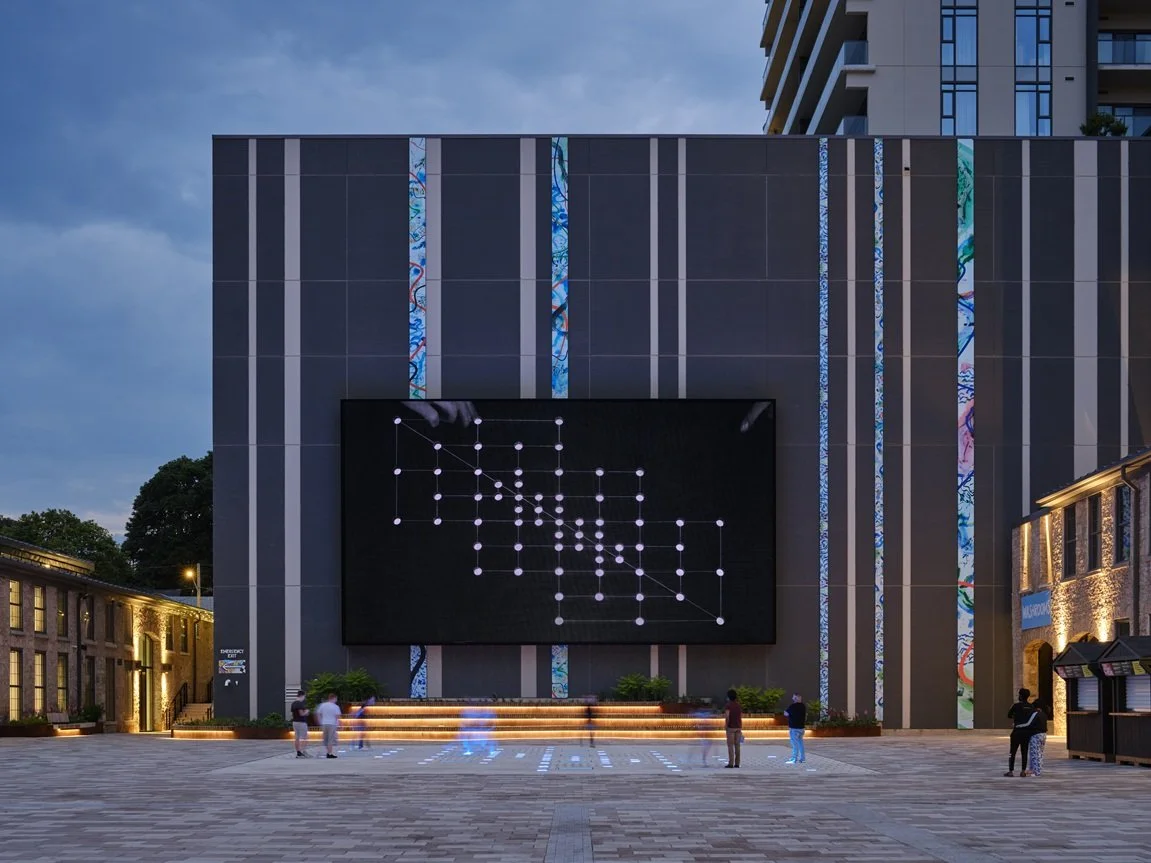
River Lines installation
River Lines is a permanent interactive pavement that turns the public plaza into a stage for “one big impromptu musical ensemble.”
Wave-patterned pavement is embedded with 65 light rings and sensors, and different instrument sections are assigned to positions across the pavement’s surface. Players connect the dots to create arpeggiated clusters of notes that harmonize with the playing of others. Meanwhile, a large screen overlooking River Lines plots the players’ movements on an animated map for everyone watching.
The project’s design highlights how central the river once was to the rhythms of community life here.
“As you cross the courtyard, the pavement starts singing under your feet, and is an invitation to either take a little detour or stop for a couple of seconds or more, and maybe play a few tunes if you feel like it, play around and engage with the environment in a different way,” Mouna said.
“For us, these projects are also meant to ask the question, ‘if we can make pavement that sings under our feet, what else could we imagine collectively for our cities?’”
Talking points
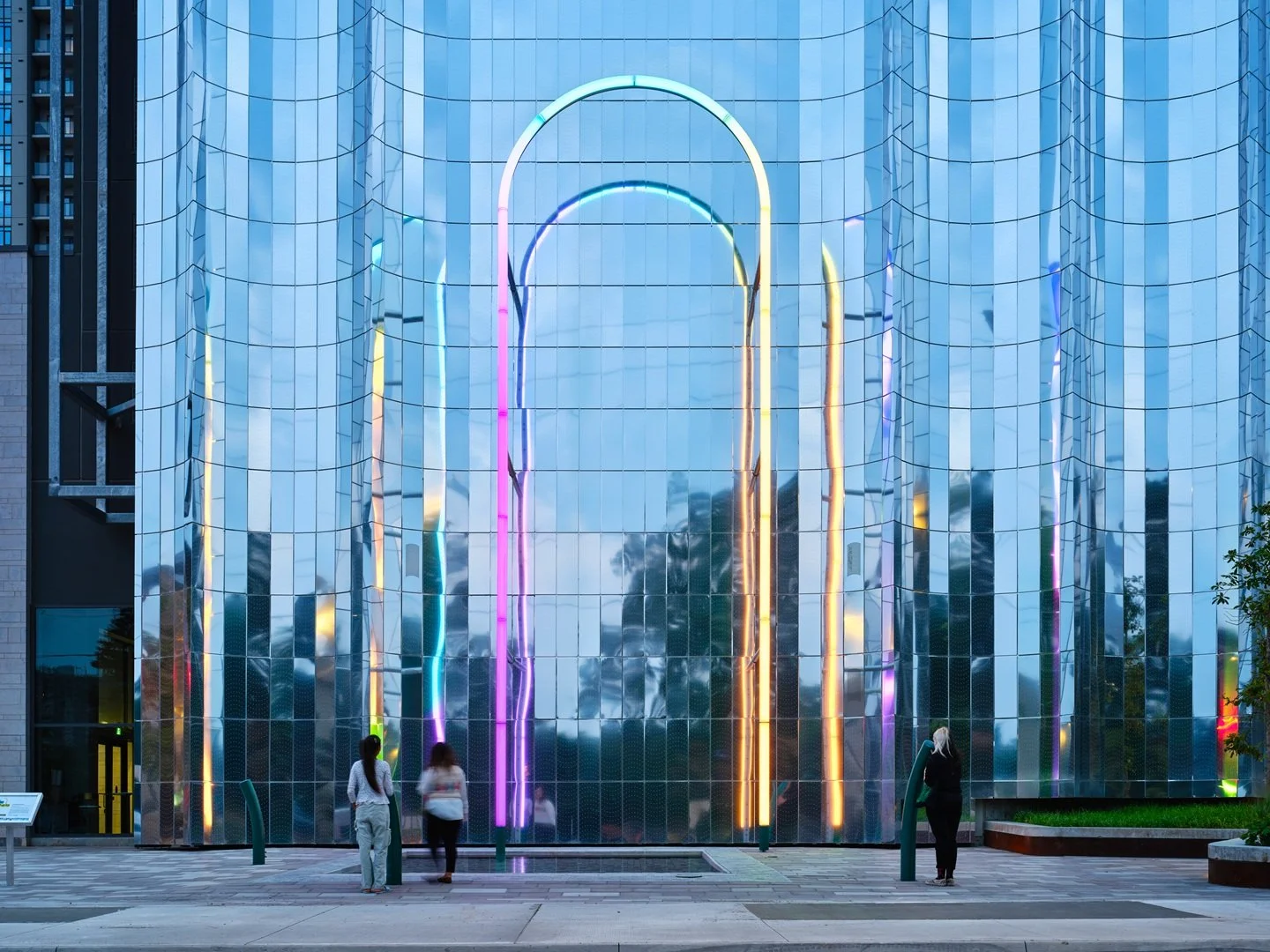
Hello Hello installation
The second piece, Hello, Hello, is a poetic messaging system inside a giant luminescent arch, which turns people’s attempts at communication into music and light. A radiant five-storey archway and reflective facade overlooking the banks of the Grand River serve as the “front yard and welcome mat” for the new district.
Passersby can deliver a greeting or message at one of three mic stations. Voices travel up the archway in shafts of colour, transforming into a playful message of music and light. The wave-sculpted facade that serves as Hello’s backdrop reflects the constantly evolving scene behind it.
The piece is inspired by the kids’ game of broken telephone, where the inputs and outputs don’t always exactly match.
“It's more like a big gesture out to the world,” Mouna said of the permanent installation, adding this piece was also about making the entrance to the district “a little more celebratory.”
Unique reactions
Reactions to the art are as unique as the individual participating.
“Every piece is different, every person is different. Sometimes they just walk by, and sometimes they walk by and they look with a little bit of curiosity, and then the second time they come by, maybe they'll slow down or try something, and the third time they see someone engaging, and they realize there's an invitation there for them,” Mouna said.
The goal with each piece is to make it “clear and accessible,” she said.
“In all of our pieces... we try to design for what we call different levels of engagement. So making sure people have different opportunities to interface and interact with the piece, whether it is as just a passerby, viewer, someone who interacts moderately, or someone who knows all the tricks and explains them to everyone and brings people on.
“It's that diversity of engagement that we think is really important to support and not judge because it reflects also the diversity of who we are and how we want to engage with the world.
“So being able to have all of these experiences around is, I think, something that's important. We put projects out there, we test them, but until they're in the real world, it's really hard to fully know how people react, what they think, how they engage, and they teach us back so many things when we watch.”
Daily tous les jours was founded in 2010 by Mouna and Melissa Mongiat. They have created more than 60 projects globally, aimed at encouraging citizens to play an active role in the transformation of their cities, with the public spaces we share every day as the canvas.
“There is an attachment that can happen to a piece. People want to share it with other people. If they had been there longer, then that creates kind of a process by which some of the pieces become destinations or rituals people enjoy. Through these processes, we can start to see this idea of pieces becoming social infrastructure.”
‘Strangers Need Strange Moments Together’
The studio’s site includes the provocation ‘Strangers Need Strange Moments Together,” which became the title of a book the co-founders co-authored in 2025.
Mouna said that sentiment has “really been this kind of driving force behind what we do.” It’s about trying to “find ways to embody this idea that we feel like we need to connect with each other in different ways, and the public realm is one of the last remaining places where we have opportunities to encounter people that maybe we wouldn't necessarily interface with, that we don't necessarily agree with, or who are from different socioeconomic backgrounds.”
It feels like we have to continue making sure we have these free open spaces for these opportunities to happen and for us to understand that a stranger doesn't necessarily mean someone negative... because this is how we can start, you know, restitching through strangers, this very loose social fabric that's so critical ultimately to the resilience of a community.”
As to Mouna’s hope for what one might get from their experience with these artworks?
“Hopefully the installation is igniting in people a sense of possibility for where they live. That the environments that we live in can be responsive and can also be caring for how we feel and supportive of our relationship with each other. And if it can open up a little bit of that door in people's minds, I think we get excited,” she said.
Mouna encourages any cities or organizations exploring similar creative ideas to take the plunge.
“Advice is tough, but mostly take risks and try things out and don’t be afraid to experiment with different ways of engaging with residents and the general public in different ways, and trust that people will generally cherish and behave in a positive way when we offer them something that is worthy of their attention, and that shows care and attention,” she said. “Also understanding that there are direct economic benefits, social and economic benefits of these investments, so even though these installations might look like hefty commitments, it's proven when done right, with the right support around them, that it can be the beginning of a positive cycle of revitalization, and re-engagement, economically, and socially, of areas and neighbourhoods.”
To learn more about Daily tous les jours, visit dailytouslesjours.com/en. To explore more about the Gaslight District, visit gaslightdistrict.ca.
For more information on Waterloo Region Community Foundation’s Vital Ideas Report about Social Infrastructure and Places, go to wrcf.ca/vital-signs.